How Many COVID Vaccines Are Enough?
Thoughts on perpetual boosters & vaccine hesitancy

“Once the revolution of exploitation is under way, statesmanship and craftsmanship are gradually replaced by salesmanship. Its stock in trade in politics is to sell despotism and avarice as freedom and democracy. In business it sells sham and frustration as luxury and satisfaction”
—Wendell Berry, The Unsettling of America
In December 2021, I found myself working in the ICU for the first time as a family medicine intern. It was peak Delta wave on the West Side of Chicago. I served the neighborhood of Austin, disproportionately debilitated by opioid overdoses, gun violence, and incarceration, not to mention COPD, diabetes and asthma. Here, there is also a deficiency of parks, trees, and grocery stores. In their place, there are corner liquor stores and boarded-up businesses. In Austin, any existing health exists on unstable ground. The neighborhood is 75% Black and 17% Hispanic.
During that month, I saw COVID deliver fatal blows to this socially vulnerable neighborhood.
In the ICU, patients fought COVID for days, even weeks, on the precipice of respiratory collapse. Beyond the standard treatment, I often felt little could be done, but wait for a victim’s fate to unfold.
That month, I followed Mr. A for several weeks. His chest x-ray was typical for COVID-19: diffuse airway opacities. With every breath, his head bobbed as he strained to pull every possible molecule of oxygen into his lungs. He was so sick, he went a week without eating. I reluctantly disclosed that if his condition worsened much further, we would recommend intubation. Days wore on and he continued to require CPAP with 100% oxygen. His likelihood of survival was diminishing.
Mr. A was occasionally delirious. But in moments of lucidity, he asked for every conceivable intervention, besides intubation. One day, through gasps of air, he yelled a surprising request: vaccination against COVID-19. He had declined vaccination prior to becoming ill. Now, he wondered if getting vaccinated on the cusp of death might save his life.
At the time, research did show that prior vaccination might have saved his life.
Fortunately, his condition improved and the topic was not revisited.
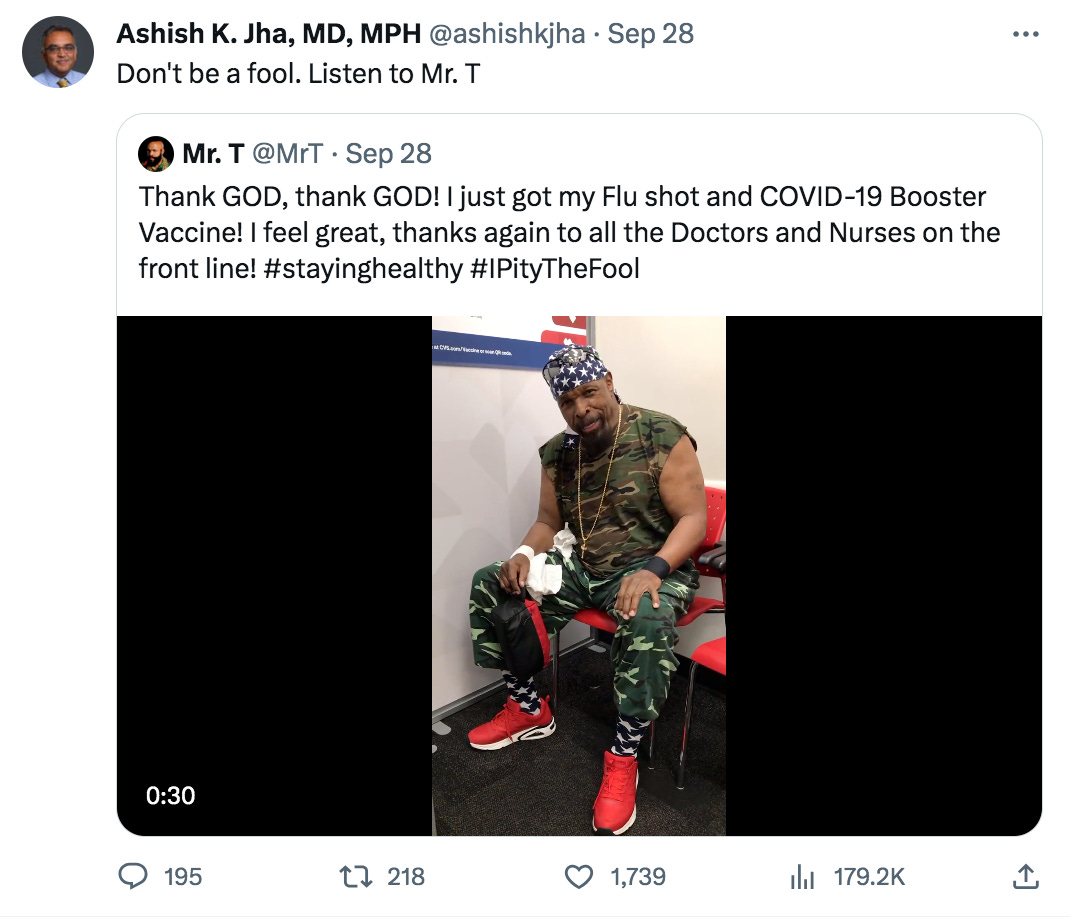
Public opinion on COVID vaccination is often portrayed as a battle between Republican and Democrat ideologies. The predictable outcome has been mass hysteria. The politicization of COVID science has rendered objective public education an impossibility. Evidence-based debate on past and future COVID vaccines is absent from the media. Instead, the public is informed by fear tactics, political tribalism, and celebrity endorsements.

In Austin, I’ve found that vaccine hesitancy rarely originates from political ideology. Here, Joe Biden won 90+% of the neighborhood’s vote. Yet, vaccine hesitancy is pervasive. Perhaps, this was to be expected. From scientists to politicians, expert opinion has routinely failed to uplift this neighborhood from disarray.
Perhaps there is an excess of experts and a deficiency of informed consent. This phenomenon persists within and beyond Austin.
Last week, the New York Times published the article “Three Shots for Fall: What You Need to Know”. It contains an eerie absence of “need to know” information. The reader is expected to accept expert opinion at face value. A decent article might have attempted to answer at least one of these questions:
Which trials led to the approval of these vaccines?
Were they high in quality? What were their limitations?
What is the likelihood of adverse events? Do certain demographics experience them more often?
How debilitating are adverse events?
How often will vaccination prevent hospitalization and death?
Does vaccination prevent infection or transmission?
On average, how many days will be added to a vaccinated person’s life?
What is the cost?
The New York Times does not adequately address these questions.
But I will try to fill in.
Benefits
The CDC recently outlined benefits to expect from repeat COVID vaccination in 2023. The new vaccine is heralded for boosting antibody levels against new variants. But this is hardly a “benefit”. There is no proven correlation between antibody levels and the prevention of severe illness and death. Direct evidence on hard clinical outcomes is needed.
Upon announcing the new XBB.1.5 vaccine, the CDC estimated the quantitative benefits we might expect from the new booster. They estimate the following benefits for every 1,000,000 doses in each demographic:
6 months – 4 years: Avoid 103 hospitalizations
5 – 11 years: Avoid 16 hospitalizations
12 – 17 years: Avoid 19-95 hospitalizations, 5-19 ICU admissions, and “perhaps one death”
18 – 49 years: Avoid 75 hospitalizations
When an effect size is so minuscule, it becomes crucial to avoid biased data collection in formulating these estimates. Ideally, this is done via randomized controlled trials. But instead, the CDC relies upon observational data. A recent publication in the NEJM demonstrates that observational data exaggerates the benefits of boosters against COVID. Benefits might be exaggerated by an entire order of magnitude. This is due to the “healthy vaccinee bias”—people who choose vaccination are generally healthier, even before getting a vaccine.
Harms
According to randomized controlled trials, the following are estimated risks per 1,000,000 COVID mRNA vaccines:
Pfizer: 1,010 serious adverse reactions
Moderna: 1,510 serious adverse reactions
Serious adverse reactions are defined as “death; life-threatening at the time of the event; inpatient hospitalization or prolongation of existing hospitalization; persistent or significant disability/incapacity; a congenital anomaly/birth defect; medically important event, based on medical judgment.”
The EudraVigilance database compares the COVID-19 vaccine to the influenza vaccine. COVID-19 vaccines seem to cause more allergic reactions, arrhythmia, general cardiovascular events, coagulation, hemorrhages, gastrointestinal, ocular, sexual organs reactions, and thrombosis. More commonly, the mRNA vaccine seems to cause more fever and days of work missed.
Myocarditis is a notable adverse reaction occurring about 100-300 times for every 1,000,000 doses among males <40 years old. The severity of myocarditis ranges from mild to debilitating. The risk is lower in other demographics.
The CDC claims that myocarditis occurs more often after infection than vaccination. But even here, the CDC may be wrong. A publication in JAMA found a 28x higher myocarditis rate in young men after vaccination, compared to after infection. Either way, we ought to ask: should young people repeatedly expose themselves to harm with minimal benefit?
Unknowns
At the beginning of the pandemic, randomized data showed that two vaccines in short succession reduced the incidence of COVID infection (Pfizer, Moderna). We know with a high degree of certainty that the first few vaccines saved lives among vulnerable populations.
The mortality benefit of repeat vaccination is a major unknown. We should design trials to evaluate the frequency of death of all causes after COVID boosters. Similar to mammogram screening, the net harms and benefits going forward could be a wash. Might repeat vaccination even be a net hazard?
We need to revisit this question.
Data from Guinea-Bissau in 1981 demonstrated increased all-cause mortality in babies following DTP vaccination. The effect size was surprisingly large in females: a ten-fold increase in mortality rate. Sometimes such findings do not reveal themselves unless they are intentionally studied with randomized controlled trials. In this case, increased mortality after DTP vaccination was confirmed with additional trials.
While the DTP vaccine is not used in the United States, this is an important finding in the field of global health and an important story in the history of vaccine science.
We should rigorously assess COVID boosters with high-quality trials. How will we ever know when enough is enough?
Final thoughts
In September, I spent another month in the ICU. It was a different experience, to say the least. A single patient had COVID. But he was admitted with severe heart failure, likely the main culprit of his respiratory failure. I somehow doubt the new booster would have prevented his hospitalization.
With the available data, comparing harms and benefits is not straightforward. Just before the pandemic, Adam Cifu asked, “Should Evidence Come with an Expiration Date?” In 2021, we had decent data to support vaccination at that precise moment. But now, the virus usually causes mild illness and most people have some form of immunity.
The original COVID vaccine trials have expired.
A large randomized trial to simultaneously evaluate the ongoing harms and benefits of boosters should be enacted. This was not required by the FDA for the newest vaccine. Instead, the FDA only required Pfizer to study the new vaccine on 10 mice. Moderna only studied theirs on 50 humans. One person (2%) had a serious adverse reaction. Details about this adverse reaction have yet to be disclosed.
Based on available data, it seems the likelihood of harm is 10-100x greater than the benefit among people <50 yo. A risk-benefit analysis published last year also suggests an unfavorable risk-benefit analysis for people aged 18-29.
In the UK and Australia, repeat COVID vaccination is not recommended under 65 years old. This might be sensible. I would like to know if older or immunocompromised people would benefit. But we don’t have data to prove this.
The only clear winner is Moderna and Pfizer. Perhaps they were once heroes. However, they have convinced the CDC and the FDA that perpetual COVID vaccination is necessary without robust data. They have convinced taxpayers and consumers to spend over $100 per dose, 4x the cost of prior vaccines.
As the only country vaccinating 6-month-old infants, we better produce the best data in the world. Instead, we have antibody titers from 10 mice.
The CDC and FDA are whittling away at public trust by forgoing their duty to protect and inform. Meanwhile, their recent actions are aligned with the financial interests of Pfizer and Moderna.
Consent to perpetual COVID boosters is not informed, it is being manufactured.
A special thank you to Clarissa O’Conor who has helped channel my frustrations into constructive outlets. Thank you Sam Weiss, Katie and Mom for your critical and supportive feedback. Thank you all for reading, sharing, and commenting on- and off-line. You encourage me to continue.
Thank you for looking at the science or lack of .. on these Covid vaccines. I saw the CDC has a vaccine schedule with the Covid vaxx for kids as young as 6 months.. I would never give my child this Covid vaxx.. it has never been approved. I appreciate your perspective
Hi Wil, you make a lot of good points here! I’d like to point out a few considerations quick.
“Based on available data, it seems the likelihood of harm is 10-100x greater than the benefit among people <50 yo”
I think this is a false equivalency. If you define “harm” from vaccines as adverse effects and events deemed by medical professionals to be probably vaccine related, but only define “harm” from Covid as hospitalizations and deaths... that’s not a fair comparison. Those millions of people who receive a booster will get more protection against covid problems than just hospitalization and death. Why does no one only talk about vaccine adverse effects in terms of booster hospitalizations/deaths?
You’re right that we don’t have enough data for prospective trials for each new booster, but the fast mutation rate and incredible year round spread of this virus make any trials of updated boosters impossible. Even the XBB shots we have now are behind the curve with new variants.
I’m getting a booster as a 48 yo man. Every time we catch covid it’s a roll of the dice for our endothelial linings, cv systems, autonomic and central nervous systems, lungs, etc etc. even if they only reduce covid 50% for a few months, that’s still millions of cases prevented for a while, and fewer cumulative infections per individual.
This crap gets into your coronary arteries. Into your brain. For every unknown with repeated boosters I can name you 10 more regarding the unknown long long term effects of repeated covid infections.
I wish there were studies on booster VE for long Covid... but so many variables and previous infections I think isolating a consistent population to study this question in will be difficult. Vaccination definitely reduced long Covid.
Anyway, pharma profits are always a motive, just like going to work tomorrow for all of us is motivated by a paycheck. But there are lots of other motivations for both, too.
Keep up the critical thinking here, I don’t have all the answers, but I hate hate hate Covid and I’ll throw everything I personally can at it.